The Iron Throne: When a Description Becomes an Icon
The book's threatening mass of blades and the television seat solve different visual problems.
Spoiler scope: General throne imagery and television season 8.
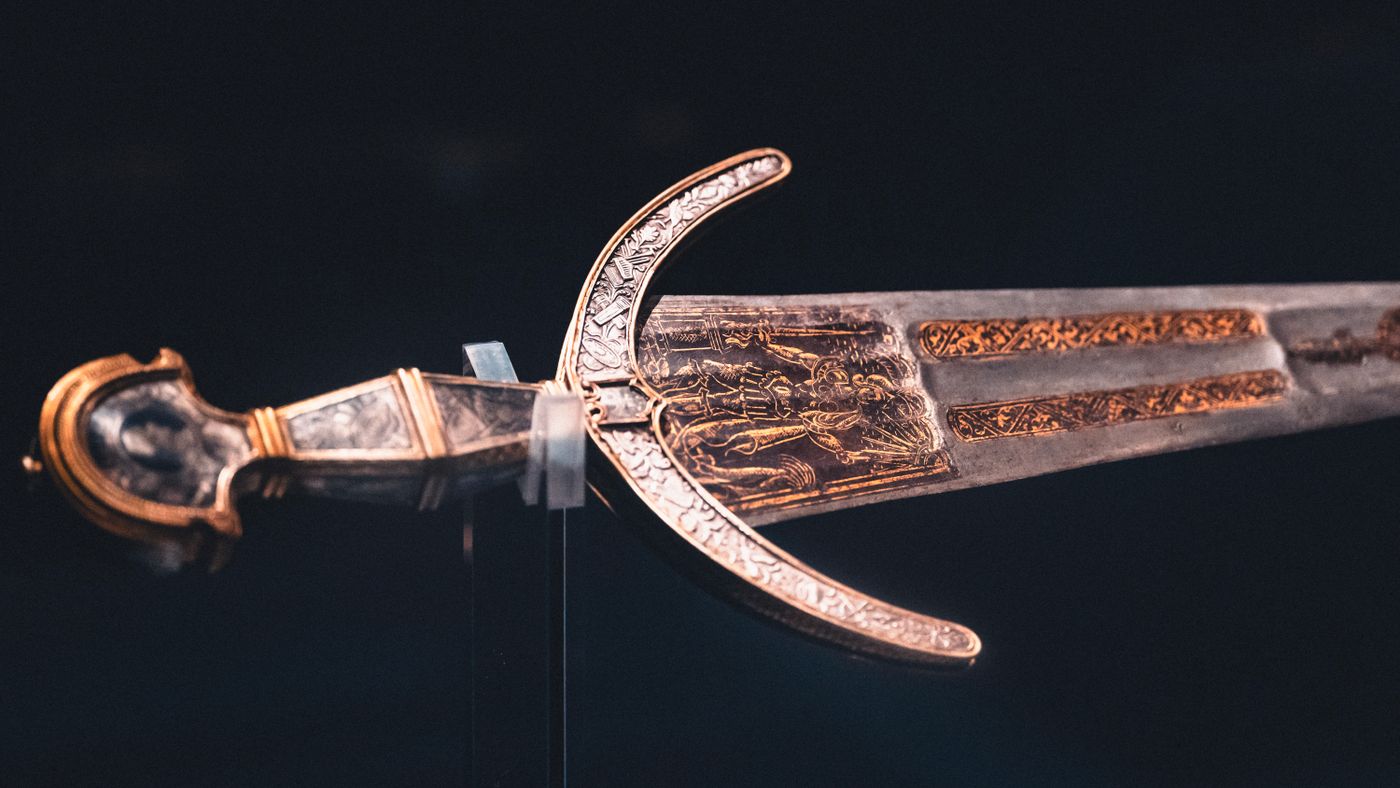
A seat that refuses comfort
The Iron Throne is a piece of furniture that turns the founding violence of a regime into an everyday object. A monarch cannot sit without occupying a reminder of defeated enemies. The point is not simply that the seat looks impressive. Its material makes conquest part of the posture of government.
In his discussion of the throne's appearance, George R. R. Martin emphasises the scale, asymmetry and intimidating height he imagines. The television design is more contained and immediately recognisable as a silhouette. Both remain assemblies of swords, but they distribute attention differently: one threatens to dominate an entire architectural space, while the other concentrates the idea into a readable screen object.
The camera needs a relationship
A prose description can insist on a size that a reader pictures differently every time. A filmed set must also accommodate bodies, entrances, eyelines and repeated conversations. A seat is not only seen alone in an establishing shot; it must work behind a face and across a room. That practical requirement does not make any particular design inevitable, but it helps explain why literal measurement is an incomplete test of an adaptation.
Notice what happens when a claimant stands beside the throne rather than sitting on it. The object can become a promise, an accusation or a rival for attention. Its repeated presence lets the series establish a visual grammar with very little explanation. The audience learns to read a room according to who approaches the chair, who stays below it and who is denied the chance to occupy it.
An ending can change the object
The television destruction of the throne makes material what political arguments have long implied: the symbol can be broken without automatically resolving the problems it represents. Melting the swords does not by itself explain succession, consent or the distribution of power afterwards. The image has immense dramatic clarity, while the institutional questions remain larger than the image.
Comparing the two designs is therefore most useful when it asks what each makes easy to imagine. Monumental scale makes hierarchy physically overwhelming. A compact, repeatable silhouette makes the pursuit of power portable across scenes and publicity. The artistic question is not which version contains the correct number of blades, but what experience of authority the arrangement creates.
The throne is an argument about power made visible; changing its shape changes the emphasis of that argument.
Another angle on the story.
Inside a Mind, Outside a Face: From Page to Screen
A viewpoint chapter and a close-up do not give us the same kind of access. That difference changes how we judge almost every character.
Read the essay
Lady Stoneheart and the Silence After Revenge
Omitting a character also removes a question: what remains when grief survives but mercy does not?
Read the essay
Sansa, Jeyne Poole and the Politics of a Stolen Name
Transferring a Winterfell storyline changes more than its protagonist. It changes what the marriage is meant to prove.
Read the essay